
2026-10-06 · Garrett Sullivan
Can Spray Foam Help Your Roof Stand Up to Oklahoma Hail and High Winds?
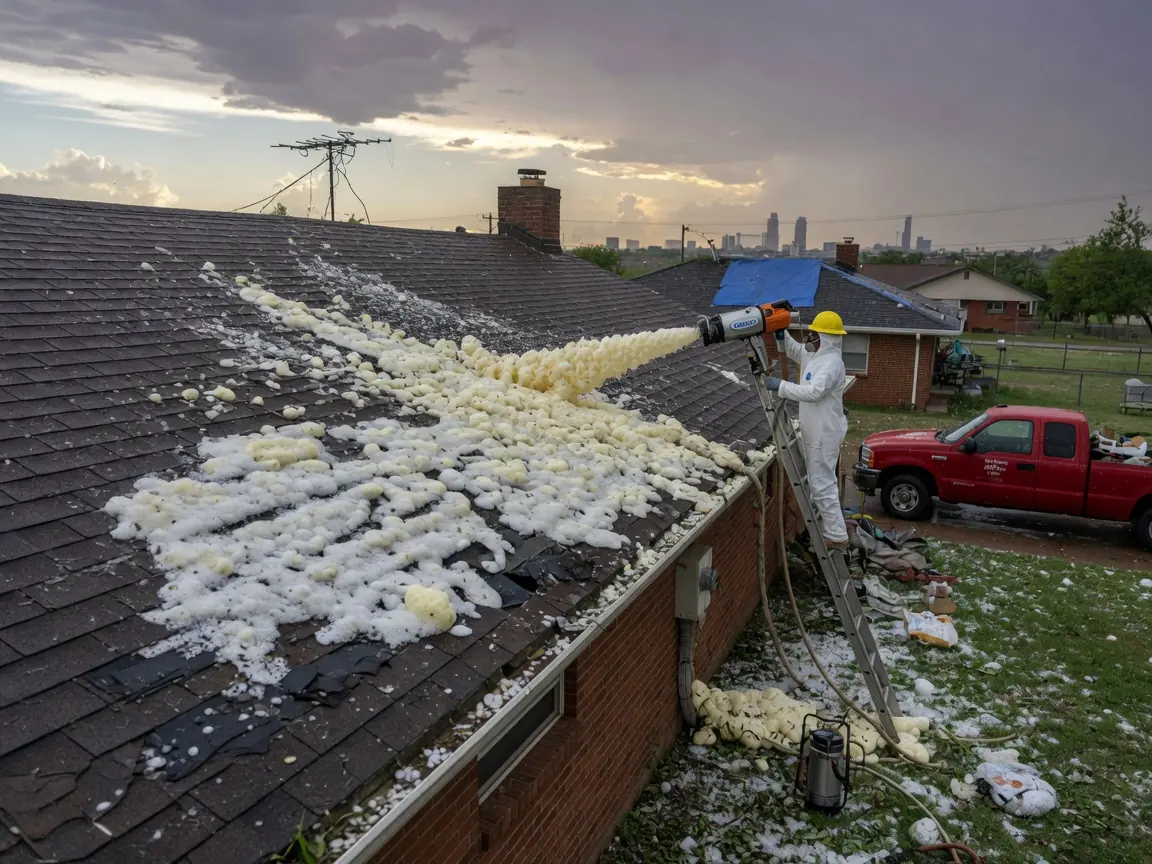
Yes, spray foam roofing can help your roof stand up to Oklahoma hail and high winds by forming a monolithic membrane that bonds directly to the deck and distributes impact forces while resisting uplift pressures that reach 90 mph or more during storms.
Oklahoma City Weather Patterns and Roof Stress
Oklahoma County sees frequent severe thunderstorms with large hail and straight-line winds that batter roofs across neighborhoods like Midtown, Automobile Alley, and The Village. Warm humid summers followed by cold winters cause repeated expansion and contraction that opens seams on traditional shingles and metal panels. These cycles weaken older housing stock built before modern wind codes, especially in Bricktown and Deep Deuce where many structures date to the early 1900s. Spray foam applied at 2–3 inches closed-cell thickness creates a continuous surface without joints, reducing the points where wind can pry materials loose. Homeowners in Moore and Midwest City report fewer leaks after foam application because the material stays flexible enough to handle temperature swings without cracking.
How Spray Foam Handles Hail Impact
Hail in central Oklahoma often reaches 1–2 inches in diameter during spring storms, enough to dent metal and crack asphalt shingles. Closed-cell spray foam absorbs and disperses the energy across a wider area instead of concentrating force at a single point. The material’s density of 2 pounds per cubic foot provides enough cushion to limit denting on underlying decks while maintaining adhesion. In Stockyards City and Capitol Hill, where metal buildings are common, foam also seals seams that hail tends to exploit. Property owners notice reduced interior water intrusion because the foam fills gaps that would otherwise allow meltwater to enter. This performance holds when the foam is applied over properly prepared surfaces and covered with a UV-resistant elastomeric coating rated for Oklahoma exposure.
Wind Uplift Resistance in Local Conditions
High winds during thunderstorms create negative pressure that lifts roof edges and corners. Spray foam adheres across the entire deck, eliminating the need for mechanical fasteners that can become failure points. The resulting system meets uplift ratings suitable for Oklahoma County gusts when installed at the proper thickness and with compatible coatings. Homes in Warr Acres and Bethany benefit because the foam also seals around penetrations like vents and skylights that wind-driven rain exploits. Unlike mechanically attached systems, there are no exposed fasteners to loosen over repeated storm seasons. This continuous bond is especially useful on the irregular rooflines found on many older homes in Nichols Hills and Del City.
Practical Considerations for Spray Foam Roofing
Application requires dry weather and temperatures above 50°F, which limits scheduling to certain windows between Oklahoma’s spring and fall thunderstorm seasons. Proper surface preparation includes removing loose gravel or damaged membrane material first. Once applied, the foam must receive a reflective coating within 24 hours to prevent UV degradation. Spray foam roofing works well on both residential and metal structures common in the region. Readers dealing with condensation issues in outbuildings may also find value in How to Stop Condensation in Oklahoma City Metal Shops and Oil Field Buildings. Thickness, coating type, and existing roof condition determine final performance more than any single product claim.
When Spray Foam Is the Right Choice
Spray foam suits roofs that still have a sound deck but suffer from seam failures or frequent hail damage. It is less ideal when structural decking itself is compromised or when access is restricted by steep pitches common on some Midtown homes. Local crews at 3401 N May Ave can assess slope, existing materials, and drainage before recommending thickness or coating systems. Homeowners in Edmond and Norman often combine roof foam with attic insulation upgrades for better overall thermal performance. Regular inspections after major storms remain necessary because no roof system eliminates all maintenance needs in Oklahoma County’s climate.